
How to build a story bible that answers back
This is a guide for writers who have never built anything by talking to an AI. It assumes no technical background and no preparation. By the end you will know the handful of sentences that do all the work.
A story bible is the second book you keep alongside the manuscript. It holds who knows what in chapter nine, the gun you put on the mantel in act one, and whether you ever explained the locket. Call it a story bible, a world bible, or a series bible. Most of us keep it in our heads, or in notes we stop trusting around the midpoint.
The kind we are building here answers questions. You talk about your book the way you would talk to a sharp critique partner with perfect recall, and weeks later, in a brand new chat, you can ask it what you decided and why.
The examples below come from a real one: an untitled science fiction novel about a station in the asteroid belt, built from a single sentence.
Three things to know before you start
Most people who freeze at the empty chat window are worried about doing it wrong, so three things are worth saying before any instructions.
Orbismo keeps the story bible, not the book. Your draft stays wherever you write, in Word or Scrivener or a notebook. What Orbismo keeps is the story underneath: who these people are, what happened, what you have decided. There are no word counts and no chapter files.
Nothing becomes canon until you say so. A new bible starts in the sketchbook stage, where everything is provisional. You can spitball ten endings and none of them stick. Things get locked when you say to lock them, and not by accumulating or by being mentioned twice.
It will not invent your book behind your back. If you have not decided who poisoned the water, it records that as an open question rather than filling in a plausible answer. When you ask it a question the bible cannot answer, it says so instead of guessing.
You cannot break it. Nothing you say is permanent, and anything recorded wrong can be fixed by saying it is wrong.
Set it up once
Create a world at orbismo.com, choose the Story Bible template, and connect the AI you already use. Connecting is a one-time thing, not something you redo each session, and the help site walks through it. In this example my world is called Ceres, after the station the book is set on.
Now talk to your AI where you always do, in Claude or ChatGPT, and the bible fills in behind the conversation. Orbismo is where it lives and where you go to browse it, not where you type.
Your first session: say one sentence
This is the part people overthink. You do not need a premise, a cast, or an outline. One sentence about the book is a complete first move.
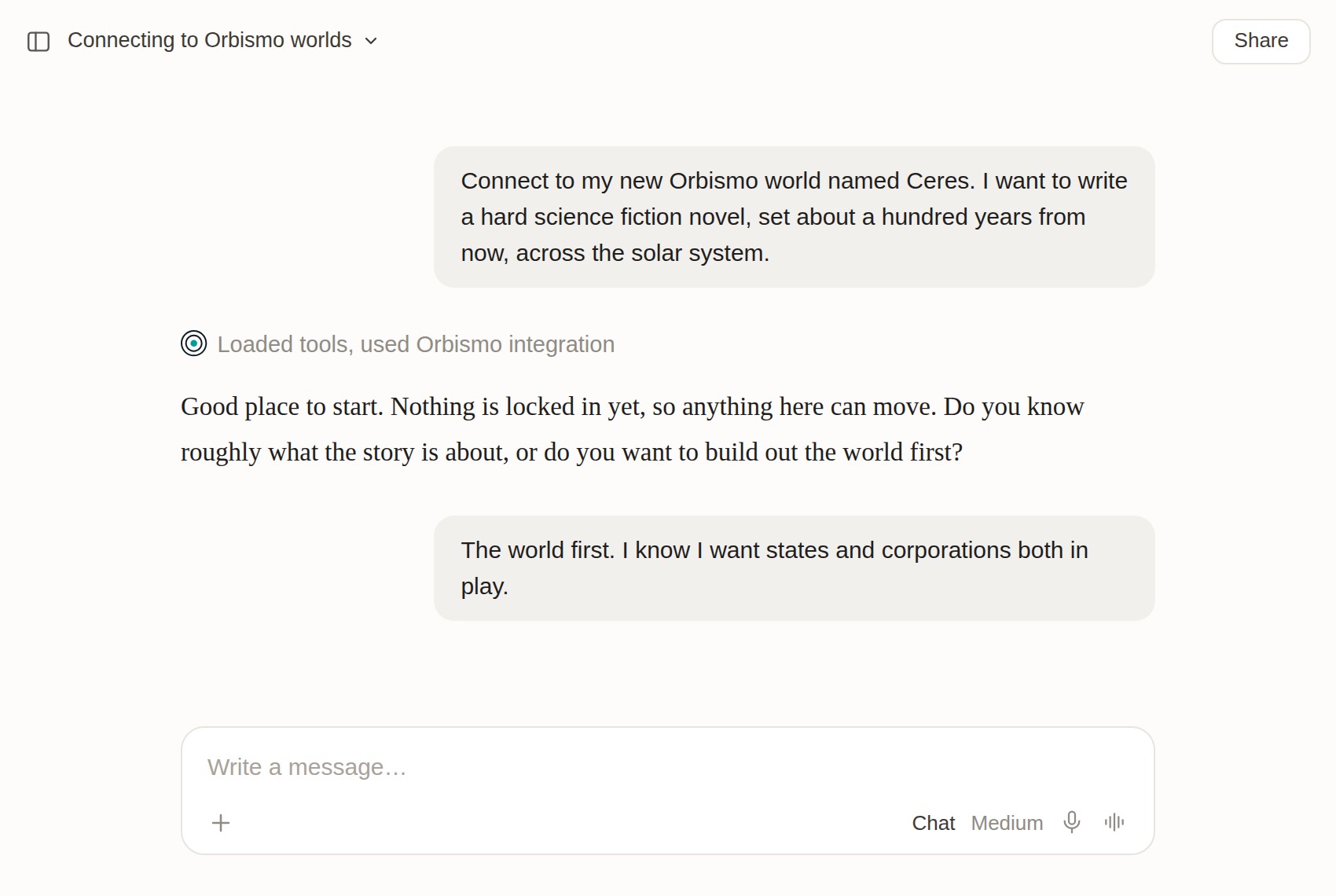 The bible starts filling in from the first thing you say.
That is a real first session. Notice what did not happen: no form, and no setup questions. If you arrive already talking, it will just keep up and fill in the rest behind the conversation.
If you would rather be asked, say so. It will interview you one question at a time and stop as soon as it has enough.
If you already have notes, paste them in. An old character list, an outline, three pages of worldbuilding from two years ago: paste it and say "this is what I have so far." It gets read, and from then on it is part of what the bible knows.
Everything after that is just describing things
There is no command language. You describe your story the way you would describe it to a friend, and it gets kept.
You: Three Earth blocs, each one sponsoring a megacorporation. One of them owns the shipping lanes, one owns the life support patents, one runs the mines. They all have a foothold on Ceres Station and none of them controls it.
All of that is kept: which corporation controls what, and that none of them controls Ceres. You did not name any of them yet, and that is fine. Name them when you know.
Characters work the same way. Say who someone is, and for anyone who matters it will ask one question at a time rather than handing you a form: who they are when the book opens, what they want, what is underneath that, how they talk. It will push gently on contradictions, and when you ask for suggestions it offers options and lets you pick.
Here is what that produced for the protagonist, exactly as it reads in the bible:
Want: Keep Ceres Station stable and off the front page of anyone's crisis briefing.
Need: To stop treating neutrality as a strategy and start treating it as a choice she keeps making, one that has a cost she has been pretending is zero.
Obstacle: She has no independent leverage. No army, no life support of her own, no real mandate beyond three corporations' willingness to tolerate her.
Change (proposed): She stops managing the balance and starts building an actual third option for Ceres, at real personal and political risk.
Note "proposed" on the last line. Her ending is a suggestion sitting in the record, waiting for you to confirm it or throw it out, and it will keep saying "proposed" until you do.
The laws of your world go in the same way. Say "in this world, the trees only remember what was true at burial," or whatever yours is, and it holds for the whole story, not just the scene you were in when you said it.
Scenes are just another thing you describe. Say "chapter one is a briefing in the governor's office, from Imogen's point of view" and that is most of a scene. It will ask roughly when in the story it happens, because it keeps the order things happened separately from the order the reader finds out.
The move nobody thinks to make: "leave it open"
When you hit a question you cannot answer yet, do not force an answer and do not drop it. Say to leave it open.
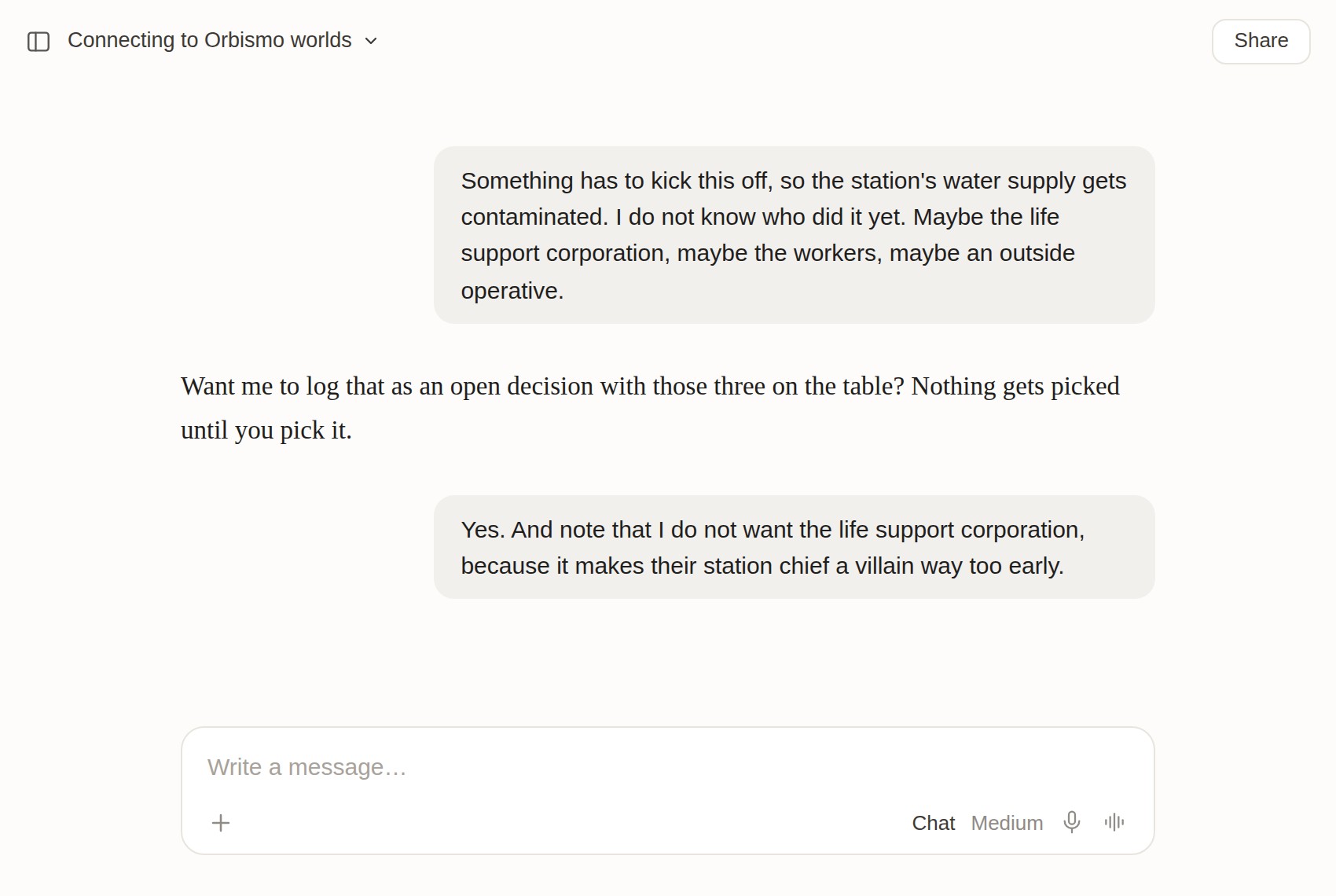 Saying why you ruled something out is what makes the note worth keeping.
That last sentence is the valuable one. Six weeks from now you will not remember why you ruled out the obvious answer, and without the note you will reconsider it from scratch and sometimes take it.
When you do decide, say so, and say how firmly:
You: Go with the outside operative, but built so it cannot be proven in the story. Not locked, I might change it.
It records that as a working answer rather than a locked one, so reversing it later is allowed and the discarded directions stay written down.
Asking your book questions
This is the payoff for all of it. All of these work cold, months later, in a brand new chat, with nothing to paste in first.
- "Where was I?"
- "What is still open?"
- "What does Imogen know about the contamination, and when did she learn it?"
- "Why did we rule out the life support corporation?"
- "Who was in the room for the briefing?"
- "What does the reader know by the end of chapter one?"
Answers come from what you stored. Where the record is silent, you are told it is silent.
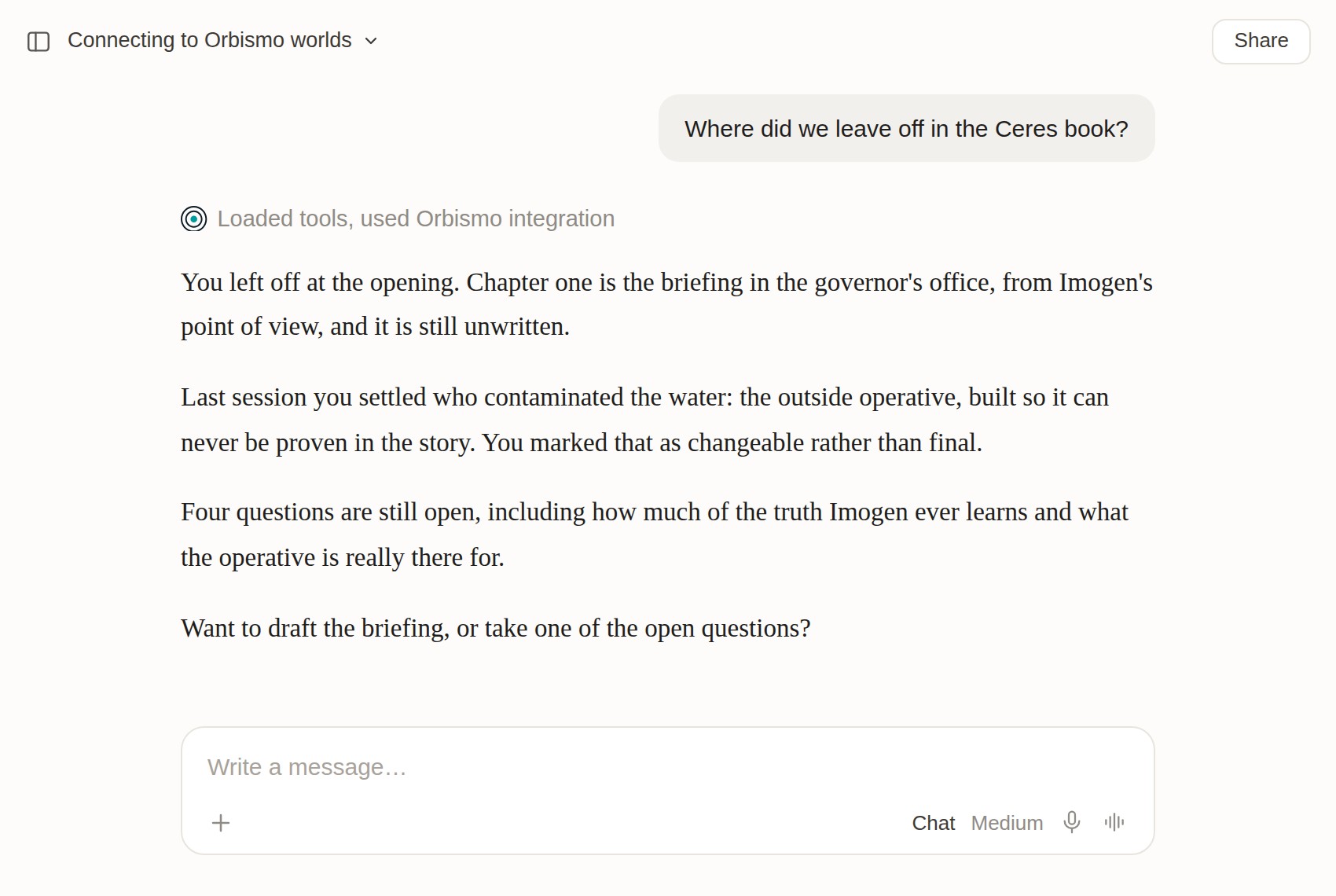 A brand new chat, weeks later. It already knows where the book stands.
A phrasebook
Nothing here is a command. These are ordinary sentences, and you can vary them however you like.
| When you want to… | Say something like… |
|---|---|
| Begin | "I want to write a novel about ___" |
| Hand over what you already have | "Here are my notes so far" (then paste) |
| Build the world | "There are three factions. One of them ___" |
| Build a character | "My protagonist is ___" / "Interview me about my protagonist" |
| Declare a law of your world | "In this world, ___" |
| Park a question you cannot answer | "Leave that open" / "Log that as an open decision" |
| Say why you ruled something out | "Not ___, because ___" |
| Decide, but reversibly | "Go with ___, but I might change it" |
| Settle something for good | "Lock that in" |
| Log a scene | "Chapter ___ is ___, from ___'s point of view" |
| Fix something recorded wrong | "That is wrong, she never ___" |
| Get re-oriented | "Where was I?" |
| Interrogate the story | "What is still open?" / "Did I ever explain ___?" |
Start your own
Say one sentence about your book. That is the whole first step, and the Ceres novel above started with exactly that much.
Your first Basic world is free for life. There is no credit card and no trial clock.
If you are new to all this, start with what a world your AI remembers actually is, then come back.
Build a story bible your AI remembers. Create your free world
Questions? We are at orbismo.com/support.